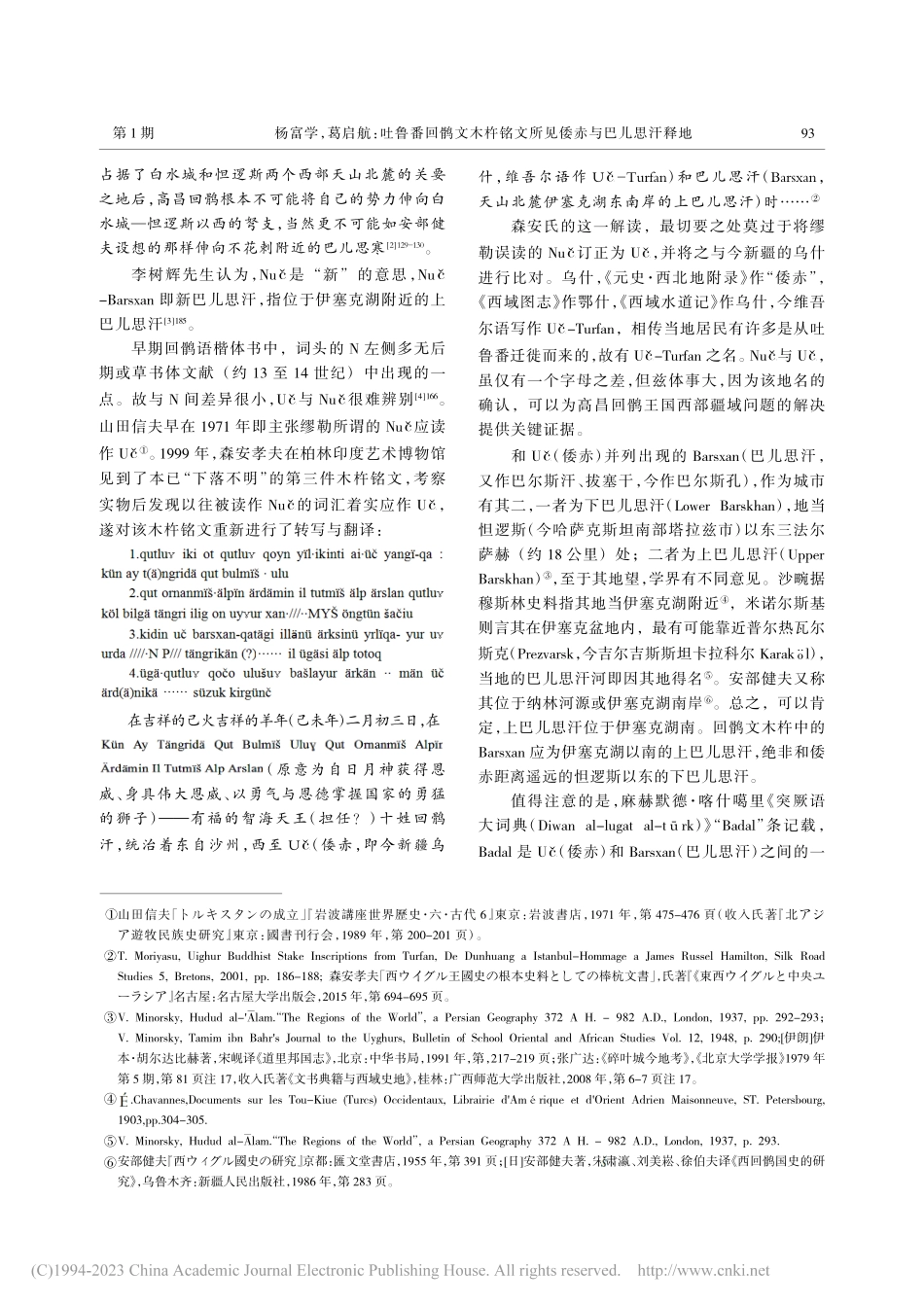
20世纪初,德国吐鲁番探险队在吐鲁番掘获木杵文书3件,现藏亚洲艺术博物馆(MuseumfürAsiatischeKunst,原印度艺术博物馆(MuseumfürIndischeKunst)),编号分别为MIKII4672(第一木杵,回鹘文)、MIKII7295(第二木杵,汉文)、MIKII7279(第三木杵,回鹘文)(图1)。由于这些文书内容重要,自出土之日起即引起国际学术界广泛的关注,先是拉德洛夫(W.Radloff)最早对两件回鹘文木杵进行研究,兹后由缪勒(F.W.K.Müller)对两件回鹘文连同汉文一起刊布①。关于这些木杵文书的时代,学界有人言之为漠北回鹘汗国之物,但更多的人认定其为高昌回鹘时期的UǎcandBarsxanSeeninUyghurWoodenInscriptionfromTurpanYANGFu-xue,GEQi-hang(DepartmentofHumanitiesResearch,DunhuangResearchAcademy,Lanzhou730030,Gansu,China)Abstract:ThewesternterritoryofQoǎcoUyghurKingdomanditschangeshavealwaysbeenatopicofacademicconcern,andespeciallytherecordofNuǎcandBarsxanintheUyghurBuddhiststakeinscription,unearthedinTurpan,attractsmoreandmoreattentionfromtheacademiccircles.Inrecentyears,MoriyasuTakaoreinterpretedthedocument,believingthattheso-calledNuǎcshouldbeUǎc,thatis,Uǎc-TurfaninwesternXinjiang,andthatBarsxanshouldbeUpperBarskhaninthesouthbankofYisaikeLake.HealsobelievedthatthesetwoarenotfarawayfromeachotherandthereisaroadtoconnectthemThisnewinterpretationisofgreatsignificancetotheunderstandingoftheWesternterritorialissuesoftheQoǎcoUyghurKingdom.Throughavarietyofliteraturereview,itcanbeseenthateitherin947orin1019,whenthestakeinscriptionwasbelievedtobewritten,theUǎcandBarskhanareaswerealreadyunderthereignofQoǎcoUyghurKingdom.Keywords:QoǎcoUyghurKingdom;UyghurBuddhiststakeinscription;Uǎc;Barsxan[摘要]高昌回鹘的西部疆域及其变迁,一直是学界关注的话题,尤其是吐鲁番出土回鹘文木杵铭文中对Nuǎc与Barsxan的记载,更为学界所关注,研究者众。近年,森安孝夫对该文书进行了重新解读,认为缪勒原释读的Nuǎc应为Uǎc(倭赤),即今新疆乌什,Barsxan应为伊塞克湖南之上巴儿思汗,二者相距不远且有道路相通。这一新解读对认识高昌回鹘王国的西部疆域问题意义重大。通过各种文献梳理,可以看出,在947年或1019年吐鲁番回鹘文木杵铭文撰写之时,倭赤与巴儿思汗之地...