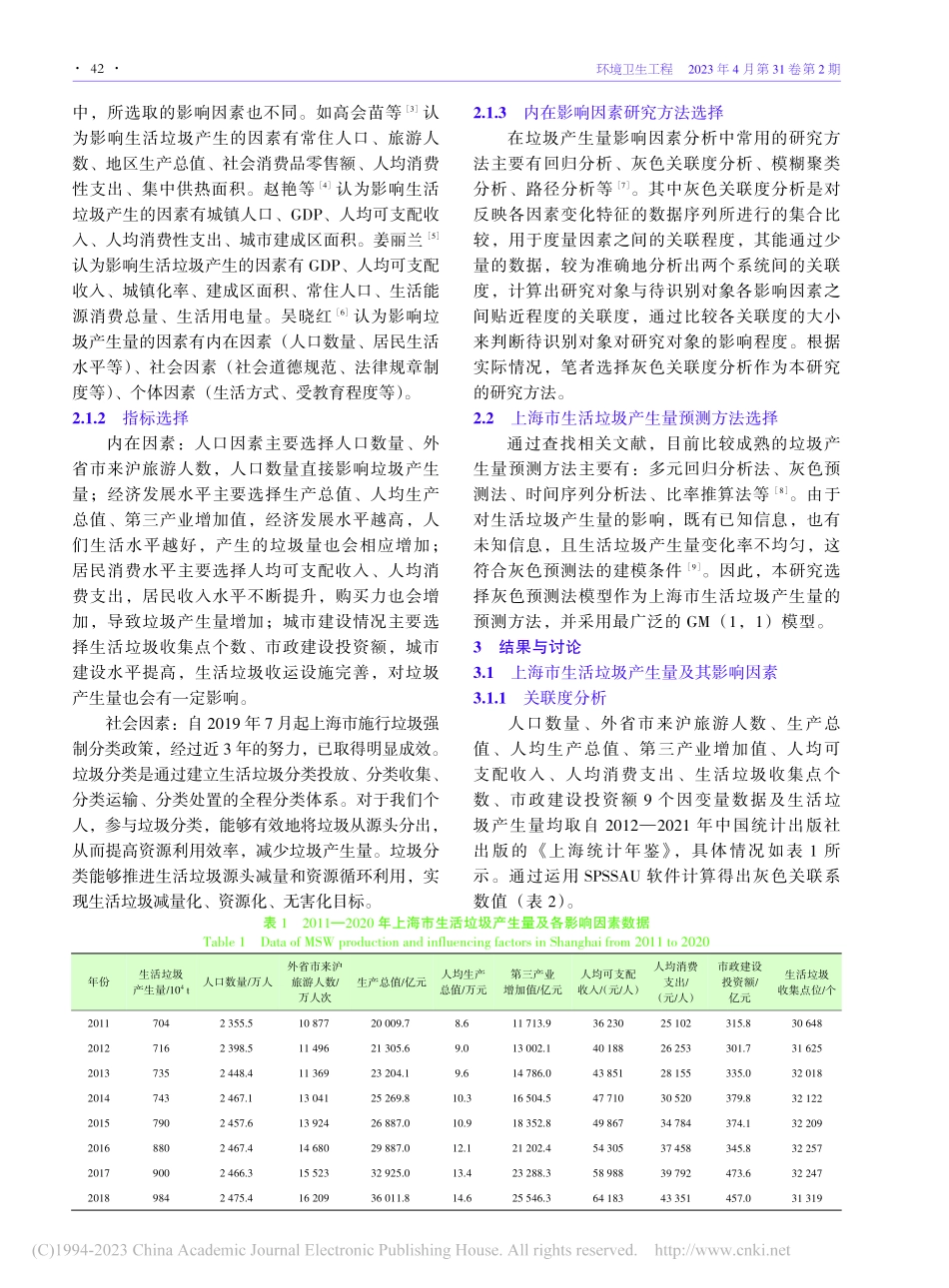
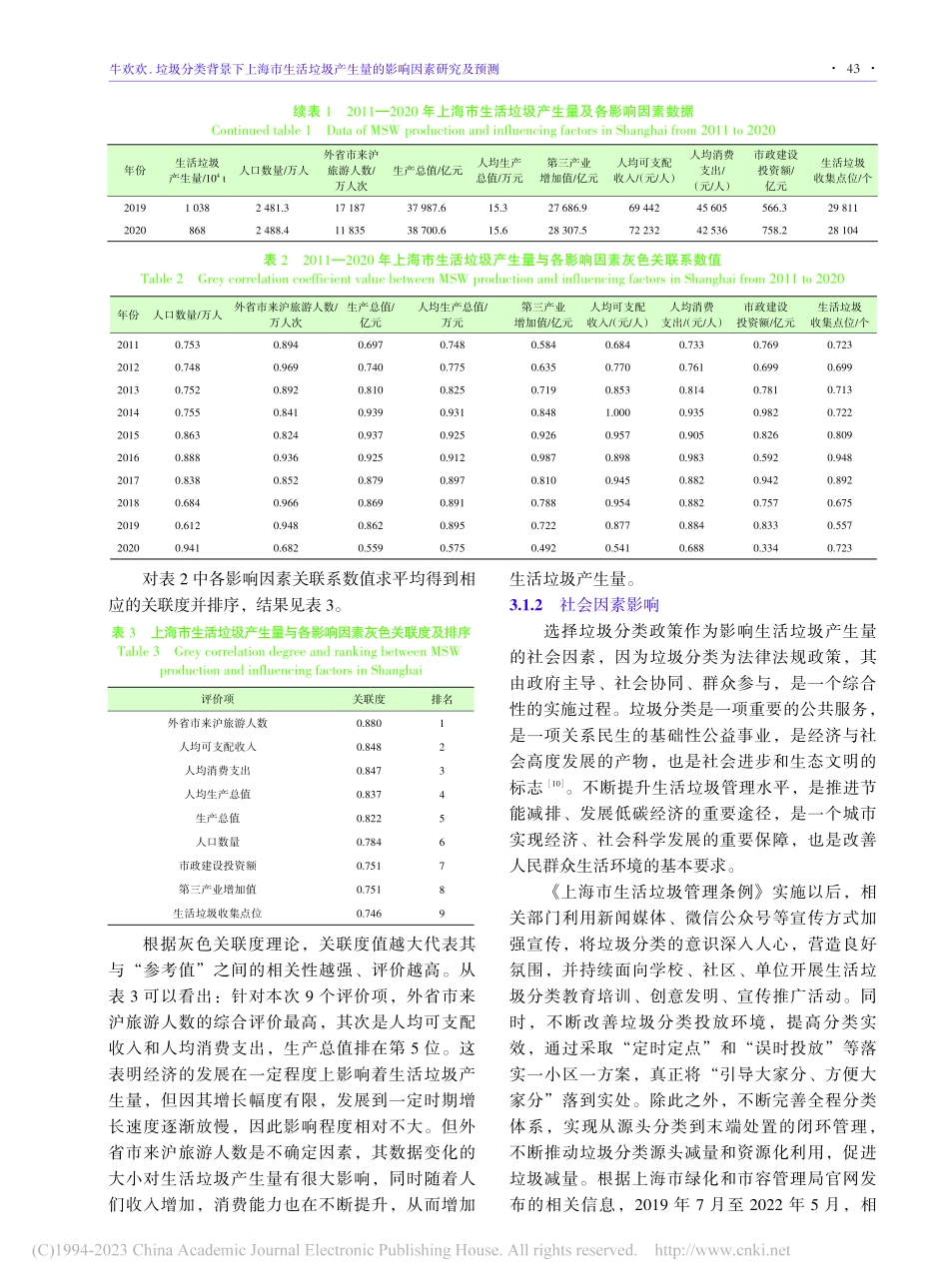
垃圾分类背景下上海市生活垃圾产生量的影响因素研究及预测牛欢欢(上海市资源利用和垃圾分类管理事务中心,上海200333)【摘要】选取人口因素、经济发展水平、居民消费水平、城市建设情况等方面作为影响上海市生活垃圾产生量的因素,利用2011—2020年生活垃圾产生量及各影响因素的数据,通过灰色关联度分析得出外省市来沪旅游人数、人均可支配收入及人均消费支出是上海市生活垃圾产生量的主要影响因素。建立GM(1,1)模型对上海市生活垃圾产生量进行预测,在考虑垃圾分类的影响下预测出2022年和2023年上海市生活垃圾产生量分别为9.723×106t和1.012×107t,为上海市生活垃圾减量及总量控制提供科学指导。【关键词】生活垃圾;产生量;影响因素;垃圾分类;GM(1,1)模型中图分类号:X32;X799.3文献标识码:A文章编号:1005-8206(2023)02-0041-05DOI:10.19841/j.cnki.hjwsgc.2023.02.007StudyonInfluencingFactorsandPredictionofMSWProductioninShanghaiUndertheBackgroundofWasteClassificationNIUHuanhuan(ShanghaiResourceUtilizationandWasteClassificationManagementAffairsCenter,Shanghai200333)【Abstract】Demographicfactors,economicdevelopmentlevel,residents’consumptionlevelandurbanconstructionwereselectedasthefactorsaffectingtheMSWproductioninShanghai,andthedataofMSWproductionandvariousinfluencingfactorsfrom2011to2020wereadopted.Throughgreycorrelationanalysis,itwasconcludedthatthenumberoftouristsfromforeignprovincesandcitiestoShanghai,percapitadisposableincomeandpercapitaconsumptionexpenditurewerethemaininfluencingfactorsofMSWproductioninShanghai.TheGM(1,1)modelwasestablishedtopredicttheMSWproductioninShanghai.Undertheimpactofwasteclassification,TheMSWproductioninShanghaiin2022and2023werepredictedtobe9.723×106tand1.012×107trespectively,whichprovidedscientificguidanceforthereductionandtotalamountcontrolofMSWinShanghai.【Keywords】domesticwaste;production;influencefactor;garbageclassification;GM(1,1)model收稿日期:2022-04-14;录用日期:2022-08-161引言随着经济的快速发展以及人们生活水平的提高,城市生活垃圾产生量也不断增长。根据上海市统计局发布的《2021年统计年鉴》及《2021年上海市国民经济和社会发展统计公报》可知,...